
What to Print in August for a Strong September Promotion
August is a good time to prepare a September promotion. It gives you room to settle the offer, finish the artwork, and have everything ready before the campaign begins.

You probably do not need several different marketing pieces. A café might use a counter sign and a takeout insert. A retailer may choose a postcard and a window poster. A product business might only need a seasonal label.
Start with what you want customers to notice or do. Then choose one or two printed pieces that support that goal.
Begin With One Clear Offer
A September promotion could be a fall sale, a seasonal menu, a customer appreciation offer, a local
event, or the launch of a new product or service.
The message does not need to be complicated:
Book before September 30
Try our new fall menu
Visit us during our September event
Save on selected products
Bring this card on your next visit
Once the offer, audience, and next step are clear, choosing the right format becomes much easier.
For a broader comparison, see our guide to choosing the right printed marketing material.
A Postcard for One Simple Message
Postcards work well when the promotion can be understood quickly. They can be mailed, handed out at the counter, included with purchases, or given to existing customers.
Common sizes include 4 × 6, 5 × 7, and 6 × 9 inches. A smaller postcard is compact and economical.
A larger size gives the headline, image, and offer more breathing room.
A postcard usually only needs:
One headline
One offer
One main image
One clear call to action
Essential contact information or a QR code
Choose a heavier stock if the card will be mailed or handled repeatedly. For direct mail, confirm the final size, paper thickness, addressing area, and postal requirements before approving the artwork.
A Flyer or Brochure for More Detail
A flyer makes sense when customers need more information before taking the next step.
An 8.5 × 11 flyer gives you room for event details, service lists, membership offers, or several products. A half-page flyer is more compact and easy to include in a bag, envelope, or customer order.
A folded brochure works better when the information needs to be divided into sections. It can guide the reader through services, packages, menu items, product categories, or frequently asked questions.
Before designing a brochure, confirm the flat size, finished size, fold style, and panel order. Heavier paper may need scoring before folding, particularly when dark colour or heavy toner crosses the fold line.
An Insert for Customers You Already Have
An insert is one of the simplest ways to promote something new to an existing customer.

It can be placed inside a shopping bag, pickup order, delivery, or product package and used for:
A thank-you message
A referral offer
A discount code
A reorder reminder
A review request
A new product announcement
Common sizes include 3.5 × 5, 4 × 6, and 5 × 7 inches.
Measure the packaging space before choosing the size. The insert should fit naturally without bending, covering the product, or requiring a larger shipping box.
Uncoated paper is a good choice when someone may need to write on the card. Coated stock usually gives photographs and strong colour a smoother appearance.
For more ideas, see how customer retention cards can support repeat visits, referrals, and reorders.
Labels for Seasonal Products
August is also a practical time to prepare labels for fall products or limited September releases.
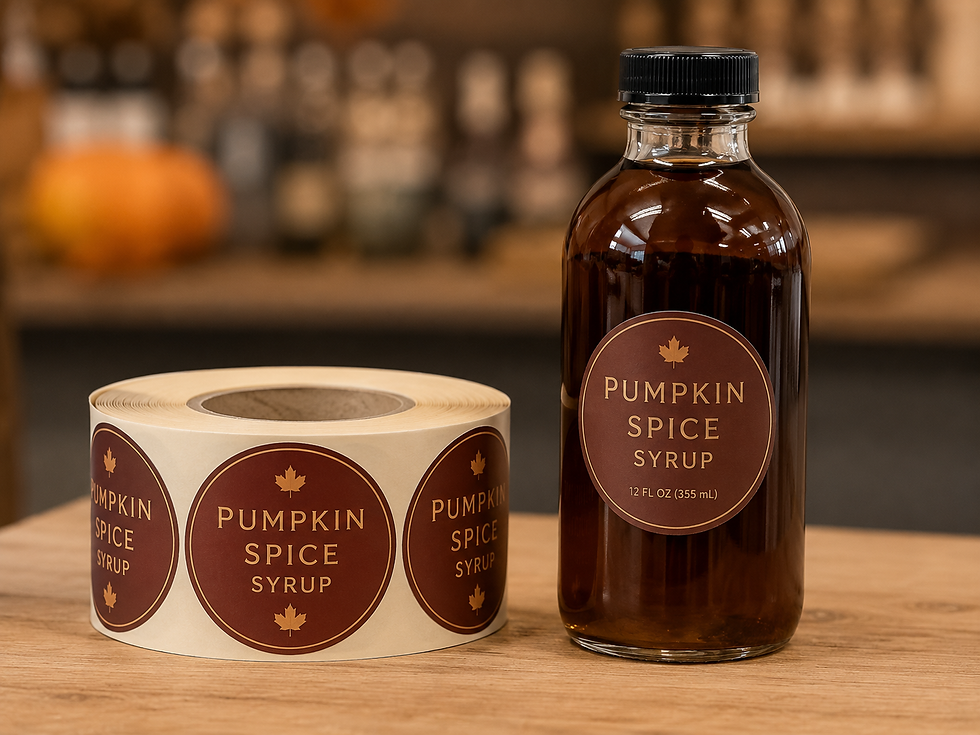
Before printing, confirm:
The final label size
The shape and surface of the container
The label material and adhesive
The quantity required for each version
Barcode size and scan quality
Roll direction for machine application
Exposure to moisture, refrigeration, or heat
For a new container or material, a small test run is often worthwhile. It lets you check the fit, colour, adhesion, and application before producing the full quantity.
Posters and Counter Signs
Signs help customers notice the promotion while they are already inside the business.
A letter-size sign may be enough for a checkout counter, reception desk, menu area, or product display. A larger poster will be easier to see across a room or through a window.
For a short indoor campaign, coated paper or cover stock may be all you need. For longer use or frequent handling, consider lamination, synthetic material, or a mounted display board.
Keep the message easy to understand from the expected viewing distance. A window poster should be much simpler than a flyer someone is holding in their hands.
AI Can Help Organize the Idea
When you have a general promotion in mind but are not sure how to organize it, AI can be useful for creating a rough outline.
You could start with:
I run a small [type of business] in Vancouver. I want to promote [offer] in September. My audience is [customer type]. Suggest one clear message, a call to action, and one suitable printed format.
Treat the result as a starting point, not finished copy or print-ready artwork. Check every date, price, product detail, contact method, and claim before using it.
The final file still needs to be reviewed for size, bleed, image quality, folds, paper, and finishing. Our AI brochure print-readiness case study shows how a useful concept still needs production preparation before it can be printed properly.
Keep the Format Practical
A short September campaign may only need a straightforward paper stock and clean design.
Upgraded finishing can make sense when the piece will be handled repeatedly, support a higher-value product, or remain in use for several months. Options may include coating, lamination, rounded corners, scoring, folding, die cutting, or synthetic material.
The right finish is the one that supports how the piece will actually be used.
August Print Checklist
Before sending the project to print, confirm:
Offer and call to action
Campaign start date
Finished size
Quantity and number of versions
Paper or material
Single- or double-sided printing
Folding, scoring, coating, or other finishing
Required delivery date
Contact details and QR codes
For print-ready artwork, include 0.125-inch bleed when colour reaches the edge, keep important text inside the safe margin, and use images at approximately 300 dpi.
A digital proof is often suitable for straightforward work. Request a printed proof or small test run when colour, paper feel, folding, label fit, or finishing is especially important.
What to Send for a Quote
Send the finished size, quantity, paper preference, number of sides, finishing requirements, artwork, required date, and delivery location.
You do not need to know every print term. A photo, sketch, or previous sample can often explain what you have in mind.
Frequently Asked Questions
How early should I prepare September printing?
August is a comfortable time to begin. Allow extra time for design, multiple versions, specialty materials, physical proofs, folding, or outsourced finishing.
Do I need several promotional pieces?
No. A postcard and counter sign may be enough. An online seller may only need an insert or seasonal label.
Should I print the full quantity immediately?
A smaller first batch can make sense when the offer is new, demand is uncertain, or you are testing several designs.
Can one design be used in several sizes?
Usually, but the layout should be adjusted for each format. Text size, image cropping, margins, and proportions may need to change.
Keep the Campaign Focused
A strong September promotion can be simple.
Start with the offer, audience, quantity, distribution method, and launch date. Then choose one or two printed pieces that fit the campaign.
Send the size, quantity, paper preference, artwork, deadline, and finishing requirements for a more accurate quote.


